How to identify an Arizona bark scorpion
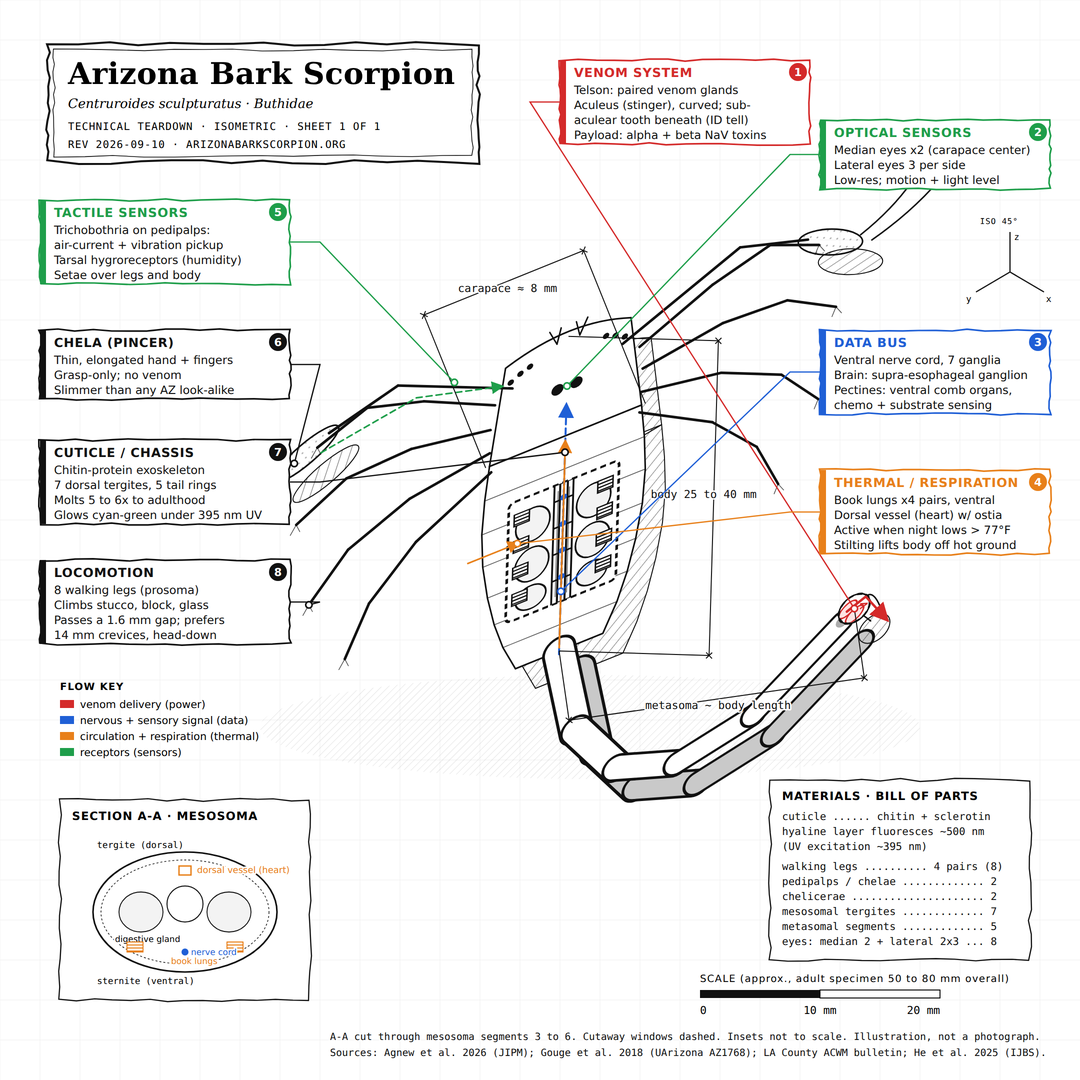
An Arizona bark scorpion is a slender, uniformly pale yellow-to-tan scorpion 5 to 8 cm long with thin, elongated pincers, a thin tail about as long as its body, and a small tooth (the subaculear tubercle) just beneath the stinger.[1][2] If it was on a wall, ceiling, or the underside of something, that is another point in favor: it is the only scorpion in the Southwest that climbs smooth vertical surfaces.[2]
What are the three tells?
- Thin pincers. The pedipalps end in long, slender hands with long fingers. Stripe-tailed and giant hairy scorpions have stout, swollen hands.[3][1]
- Thin tail, laid to the side. The metasoma is narrow along its whole length and about as long as the body. At rest, bark scorpions typically lay the tail flat and to one side rather than arching it over the back, a posture described in the 2026 Journal of Integrated Pest Management review.[2]
- Subaculear tooth. A small bump on the underside of the telson, just behind the curved stinger. It is characteristic of the genus Centruroides and is visible with a hand lens or a phone camera's zoom.[1]
How big is an Arizona bark scorpion?
Adults measure about 5 to 8 cm (2 to 3 in) including the tail; iNaturalist's summary gives males up to about 8 cm and females up to about 7 cm, and the JIPM review reports a typical adult length near 70 mm.[4][5][2] Extension guidance rounds this to "about two inches" for the body.[6] That makes it a mid-sized scorpion: smaller than the giant hairy scorpion, which reaches 14 cm, and similar in body length to the stripe-tailed scorpion but visibly slighter in build.[7]
What color is it?
Uniform pale yellow to yellowish tan, sometimes described as straw-colored or translucent, with at most faint darker markings.[1][4] It lacks the bold dark stripes on the tail that give the stripe-tailed scorpion its name, and it lacks the dark olive body of the giant hairy scorpion.[7] Under a UV flashlight it fluoresces cyan-green, but so does nearly every scorpion, so glow alone does not identify it.[2][8]
What do the technical keys use?
Taxonomists separate C. sculpturatus from similar species by a set of characters that a homeowner will not need but that settle arguments: a sternum that narrows toward the front (subtriangular); slender, elongated pedipalp fingers; no trichobothria (sensory hairs) on the underside of the pedipalp patella; two large accessory teeth on the movable finger of the chelicerae; and the subaculear tubercle beneath the aculeus.[1] The species was lumped with C. exilicauda more than once in the twentieth century; venom chemistry and genetic work re-separated them in 2004.[2][4]
What does a baby bark scorpion look like?
Newborns are pale, almost white, and ride on the mother's back in a cluster until their first molt one to three weeks after birth.[2][4] A young scorpion on its own looks like a miniature adult, with the same slender proportions. Two cautions from the literature: a juvenile's venom is not more potent than an adult's (venom potency belongs to the species, not the age), and a freshly molted juvenile will not glow under UV for several days, so a blacklight sweep undercounts the youngest cohort.[9][8]
What gets mistaken for it?
Most often the stripe-tailed scorpion (Paravaejovis spinigerus), which is the same general size and color but has stout pincers and a thick, dark-striped tail, and the giant desert hairy scorpion (Hadrurus arizonensis), which is much larger, darker, and hairy.[7][3] Neither of those climbs walls well, and neither has a medically significant sting for a healthy adult.[2][3] The comparison page puts all three side by side. In the Phoenix area, if a scorpion is on a wall or ceiling, on a screen door, or upside down under a lip of stucco, treat it as a bark scorpion until proven otherwise.
Where can I see verified photographs?
The iNaturalist taxon page shows thousands of community-verified photographs and a live observation map.[5] Wikimedia Commons hosts CC-licensed specimen photos in its Centruroides sculpturatus category. This site's own field photographs will be added as they are processed; see the about page.
Devon "The Scorpion Guy" at ArizonaBarkScorpion.org. "How to Identify an Arizona Bark Scorpion (Anatomy Plate)." 2026-09-12. https://arizonabarkscorpion.org/identification/Related
Sources for this page
- Los Angeles County Agricultural Commissioner / Weights and Measures. Arizona Bark Scorpion (Centruroides sculpturatus) identification bulletin, 2008. file.lacounty.gov/SDSInter/acwm/215638_ArizonaBarkScorpion.pdfTier 1
- Agnew J, Bowers K, Bundy S, Romero A. Distribution, biology, and management of medically relevant bark scorpions, with emphasis on Centruroides sculpturatus. Journal of Integrated Pest Management 17(1), 2026. academic.oup.com/jipm/article/17/1/pmag029/8724371Tier 1
- Gouge DH, Li S, Bibbs C, Nair S. Scorpions of the Desert Southwest United States. University of Arizona Cooperative Extension, publication AZ1768, 2018. acis.cals.arizona.edu/community-ipm/community-ipm-output/publications/publications-view/scorpions-of-the-desert-southwest-united-statesTier 1
- Wikipedia contributors. Arizona bark scorpion. Wikipedia (cross-reference; consult its citations for primary sources). en.wikipedia.org/wiki/Arizona_bark_scorpionTier 2
- iNaturalist. Centruroides sculpturatus taxon page and observation map. www.inaturalist.org/taxa/143985-Centruroides-sculpturatusTier 2
- Schalau J. Scorpions. University of Arizona Cooperative Extension, Backyard Gardener #184, June 13, 2024. www.extension.arizona.edu/sites/extension.arizona.edu/files/attachment/Scorpions.pdfTier 1
- Arizona State Parks. Arizona Scorpions. azstateparks.com/arizona-scorpionsTier 1
- Arizona State University, Ask A Biologist. Ultraviolet Scorpions. askabiologist.asu.edu/ultraviolet-scorpionTier 2
- Keener L. Scram! Begone, Scorpion Myths! Bay Nature, October 27, 2022. baynature.org/2022/10/27/spooky-scary-scorpions-actually-not-so-much-you-arent-worth-the-venom/Tier 2